
Arc’teryx brings back the Sidewinder — and the curved zip that helped define its freeride identity
26/October/2026

Twenty-five years after its debut, the Canadian brand’s first dedicated freeride shell returns in two forms, pairing an updated silhouette with an archive-inspired edition.
The most recognisable feature of the Arc’teryx Sidewinder was never its colour, logo or fabric. It was a zip that refused to run straight. Curving away from the centre of the face, the fastening tackled a small but persistent irritation for skiers and snowboarders: a jacket collar and zip pressing against the chin when closed against the weather. Now that distinctive design is returning for autumn/winter 2026, with a contemporary Sidewinder already on sale and a separate Archive edition scheduled for November.
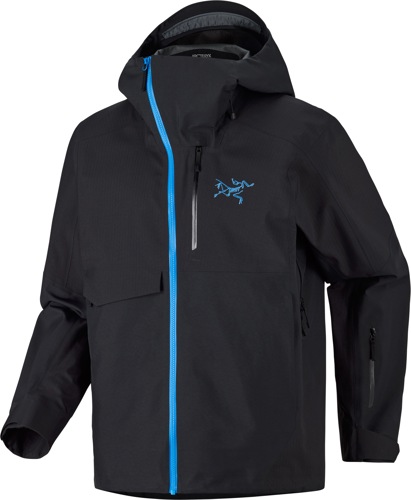
The two versions approach the jacket’s 25th anniversary differently. The new Sidewinder adopts a shorter, relaxed silhouette, updated pocket arrangements and Gore-Tex ePE fabrics. The Sidewinder Archive looks further backwards, closely following the original 2001 fit and construction while substituting modern Gore-Tex Pro ePE and recycled face fabrics. Its original Citrus and Chili colours will also return.
Together, they revisit a formative product in Arc’teryx’s expansion into skiing and snowboarding — and highlight how much has changed in technical outerwear since the company first curved a waterproof zip around a rider’s chin.
A bend with a purpose
Introduced in 2001, the Sidewinder was Arc’teryx’s first dedicated freeride shell. Its defining feature was a thermomoulded, curved WaterTight zip, engineered to move the fastening away from the chin without sacrificing the close-fitting collar needed in bad weather. The asymmetry gave the jacket an immediately recognisable appearance, but its starting point was comfort rather than decoration.
“The Sidewinder is an authentic expression of Arc’teryx design,” says Ashley Anson, the company’s vice-president of design. “Its asymmetrical construction solved a real problem for snowboarders and, in the process, challenged existing design constraints while establishing a bold visual identity rooted in mountain performance.”
That relationship between function and appearance explains much of the jacket’s enduring appeal. The curve was not an embellishment added to an otherwise conventional shell: it was the visible consequence of changing how the garment closed around the face.
Contemporary coverage of earlier Sidewinders shows that the concept remained central long after launch. In a 2018 guide to snowboard jackets, Gore highlighted the front zip’s route away from the chin alongside three-layer weather protection, underarm ventilation and room for condition-specific layering. The jacket was already an established part of the technical snowsports wardrobe, rather than simply a short-lived design experiment.
The 2026 version keeps that principle intact. Arc’teryx describes the current fastening as thermomoulded, curved and cupped, with the offset also intended to reduce the stacking of zips when several garments are worn together.
A new shape around a familiar line
Around the signature fastening, the latest Sidewinder has changed substantially.
The updated jacket combines a shorter, relaxed cut with a cinching system to adjust the fit. Offset pockets extend the asymmetrical design, while tonal colour-blocking references the earlier jacket without reproducing it outright. Arc’teryx says it worked with athletes to refine the seam lines and construction for the new model.
The women’s version, listed at £750 on the brand’s UK website, illustrates the direction. It has a women’s-specific relaxed fit, a centre-back length of 63cm in size small and a listed weight of 589g. Its specification includes a helmet-compatible StormHood, underarm ventilation, gusseted cuffs and a RECCO reflector. Storage comprises chest and hand pockets, internal mesh dump pockets, a sleeve-pass pocket and a flapped stash pocket.
Those details position it as a fully equipped freeride shell rather than a minimalist touring jacket. The shorter cut and looser shape also make fit an important distinction from longer snow shells: the anniversary styling is only part of the story, and prospective buyers will need to consider how its proportions work with their usual layers and trousers.
For Arc’teryx snowboarder Elena Hight, the connection between movement and appearance is part of the appeal.
“Snowboarding is the ultimate canvas for creativity, and how you move through the mountains and the lines you choose become part of individual style and freedom,” she says. “The Sidewinder supports that freedom.”
The bigger change is in the fabric
Visually, the zip provides continuity with 2001. Technically, the material specification marks a more substantial departure.
The new Sidewinder uses three-layer Gore-Tex ePE, combining 100-denier face fabrics with ripstop reinforcement in higher-abrasion areas. The women’s UK specification lists recycled nylon in the main body fabric and 100-denier ripstop across the yoke and sleeves. This is a substantial construction intended to withstand mountain use, rather than an exercise in making the lightest possible shell.
The ePE membrane — expanded polyethylene — is also part of Gore’s shift towards waterproof fabrics made without intentionally added PFAS, the family of substances widely associated with older water-repellent technologies. Gore describes its next-generation ePE laminates, including their durable water-repellent treatment, as made without intentionally added PFAS, while noting that trace amounts may still be present.
That qualification matters. “PFAS-free” is useful shorthand, but it should not be read as a guarantee of absolute chemical absence. Nor does a change in membrane chemistry, on its own, establish the environmental footprint of a finished jacket. Gore’s stated carbon-footprint reduction relates to the laminate’s lower-mass membrane and selected textiles, measured using the Higg Materials Sustainability Index.
For the Sidewinder, the significance is more straightforward: a recognisable older design is returning with a different generation of waterproof materials. Arc’teryx lists the new shell fabrics as free from intentionally added PFAS, while retaining the waterproof, windproof and breathable performance expected of this category. Those remain manufacturer specifications, rather than conclusions from an independent on-snow test of the new jacket.
The Archive is not the same jacket
The distinction between the standard Sidewinder and the Sidewinder Archive is important. One is a contemporary reinterpretation; the other is intended to preserve much more of the original garment’s shape and construction.
Scheduled to launch in November, the Archive retains the 2001 design language and original colourways, but uses Gore-Tex Pro ePE and recycled face fabrics. It is therefore not a literal reproduction of the old jacket: the exterior references the archive while the weatherproof construction comes from the current generation of materials.
That approach gives the anniversary collection two different purposes. The modern Sidewinder allows Arc’teryx to revisit its curved fastening within a new silhouette. The Archive offers a closer encounter with the product that helped establish the company’s snowsports identity, without requiring buyers to seek out an ageing original.
The regular Sidewinder is available in men’s and women’s versions through Arc’teryx and selected retailers, with the women’s UK model currently priced at £750. The Archive is due to follow in November; UK pricing for that edition was not confirmed in the material reviewed.
Its return ultimately poses a more interesting question than whether a 25-year-old jacket can look current. The original Sidewinder turned a practical adjustment into a design signature. This winter, that same curve feels as useful on the mountain as it remains distinctive on the hanger.
Related Articles
03/October/2026

02/October/2026

06/October/2026


