
Nevis Range Plans New Chair, Significant Investment
14/May/2026

Nevis Range has announced it is in "advanced discussions" for a major international investment package designed to completely overhaul the mountain’s infrastructure and secure its future against a changing climate.
While the resort has long been a crown jewel of Highland adventure, a combination of aging infrastructure, emergency technical failures, and the brutal reality of climate change has left many skiers asking if the "Golden Era" of Scottish skiing is melting away.
The criticism reached a fever pitch this spring as photos circulated on social media showing white peaks on Aonach Mòr while the resort’s gondola and key lifts remained stationary.
Frustrated season ticket holders and day-trippers have accused the management of "mothballing" the winter side of the business in favor of its lucrative summer mountain biking operations. However, resort officials insist the situation is far more complex than a lack of desire to open.
"It's not that we don't want to open; it's that the mountain won't let us," said a spokesperson for Nevis Range in a recent statement addressing the backlash.
After three decades as a cornerstone of Scottish tourism, the resort is pivoting away from traditional snowmaking in favor of a "smarter" model that prioritizes access to higher elevations where snow remains reliable.
Moving Toward the Snow
The proposed investment marks a strategic admission: the lower mountain infrastructure, designed for a different era of Scottish winters, is no longer fit for purpose.
Instead of fighting rising temperatures with costly, energy-intensive snowmaking, Nevis Range plans to:
Remove and replace aging lower-mountain uplift systems.
Construct a new uplift system connecting the Top Station toward the summit snowsports area.
Shift focus to where the most reliable natural snow is found.
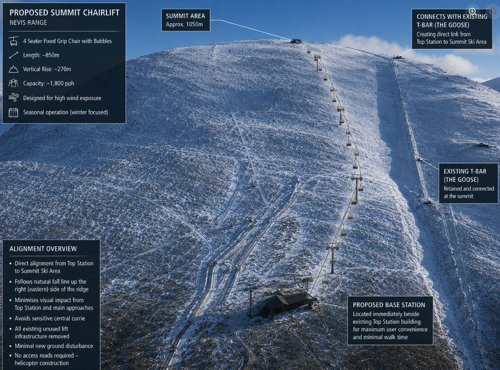
"The future of snow sports at Nevis Range is not simply about snowfall. It is about access," the resort stated. Officials confirmed that the high cost of UK commercial electricity has made large-scale snowmaking economically unsustainable, prompting the shift toward reaching natural snow higher up the mountain.
The resort has pointed to two primary reasons for the restricted lift schedule this year:
Mechanical Emergencies: Earlier this year, a routine maintenance check on the Mountain Gondola—the vital artery for all high-altitude access—revealed a serious, unexpected fault in the gearbox. This forced an emergency shutdown during the peak January window, a blow that management called "essential and unavoidable" for safety.
Fragmented Snow Cover: While the summit often looks white from the car park, officials explain that modern winters are creating "patchwork" conditions. To operate a ski area, there must be continuous, skiable links between the lifts and runs. Increasingly, the lower slopes—which connect the gondola to the higher basins—are melting out completely, leaving the "good snow" stranded at the top without a safe way for skiers to reach it.
The rationale for the limited service is grounded in a harsh economic reality. Nevis Range recently admitted that the cost of large-scale snowmaking—once seen as the savior of the industry—is no longer viable under current UK commercial electricity prices.
January Struggles: Statistics from recent years show that January now often yields only one or two viable ski days. The "Survival" Strategy: In 2024, the resort moved to a four-day week (closed Mondays and Tuesdays) and pushed the "official" start of the season back to February to conserve resources for when the snow is most reliable.
From Ski Hill to Year-Round Global Destination
The vision extends far beyond the winter months. The resort aims to solidify its status as a premier global destination for mountain biking, sightseeing, and hospitality.
Key highlights of the expansion plan include:
Enhanced Biking: The development of a brand-new "jumps line" to build on the resort's reputation as a world-class mountain biking hub.
Global Reach: Leveraging new international partnerships, particularly in Dubai and the GCC countries, which are already driving significant travel trade to the Highlands this summer.
Economic Stability: Securing the business against the "difficult economic conditions" seen post-Brexit and COVID-19 by diversifying the visitor base.
Investing in "Brand Scotland"
The potential investors are reportedly looking past the traditional "ski slope" model, viewing Nevis Range instead as a year-round adventure hub with massive global potential.
"They see the value in the mountain. They see the value in the region. And they see the global potential of Brand Scotland," the resort said in a statement. "This is about growth that allows the business to survive, invest, [and] employ local people."
"Over the last decade, we have continued investing through Brexit, through COVID, through rising operational costs and through some of the most difficult economic conditions the UK tourism industry has faced in generations.
"During that time, we have expanded the Base Station infrastructure, developed our hotel and visitor offering, grown international tourism relationships and introduced the Nevis Range story to entirely new global audiences.
"Our activities outside Scotland — particularly through our international tourism partnerships and presence in Dubai — are now generating substantial new interest in Highland tourism from the GCC countries, North Africa and beyond. And crucially, that work is now translating into real business."
While the resort hopes to secure the required investment before the end of 2026, management cautioned that projects of this scale involve significant complexities. However, they remain optimistic that this "bold new vision" will ensure the mountain remains accessible for generations to come.
"We are not standing still while the world changes around us," the announcement concluded. "We intend to build the next era of Nevis Range."


