
Split Watches' debut GMT , The watch built for people who live in the mountains
17/June/2026

Most watches sold to skiers and snowboarders have nothing to do with skiing or snowboarding. They are lifestyle products that happen to appear in mountain imagery, worn by models who look cold in a photogenic way. The Split GMT is different — not because it has an altimeter or a thermometer or any of the breathless feature lists that sports watch marketing tends to reach for, but because it was designed by people who actually understand the rhythms of a life spent crossing time zones in pursuit of snow.
London-based Split Watches was founded by Ed Margulies and Dara Amjadi, two longtime friends who asked a genuinely unusual question: what should a watch mean in 2025? Margulies is a third-generation watchmaker trained in Switzerland; Amjadi brings a background steeped in music and the kind of cultural instinct that makes a brand feel lived-in rather than engineered. Their answer, the Split GMT, is a 40mm automatic that rewards attention without demanding it.
The GMT Collection is inspired by seminal moments in music that altered the landscape forever — moments that did more than define genres; they redirected culture itself, taking people into new and uncharted waters. Dara and Ed saw a link between rivers and these moments in music. Both are always moving and never standing still, reflecting light and shade, ebbing and flowing, and always alive. From this idea, the story of the collection began to take shape.
If a watch can't survive a sub-zero wipeout in deep powder or the inevitable knocks against a chairlift safety bar, it doesn't belong on your wrist. Margulies engineered the Split GMT specifically to withstand the test of time using the very best modern, resilient materials.
"The watch must withstand the test of time. We've made it using the very best modern materials, suited to today's lifestyles," said Ed Margulies, co-founder, Split Watches.
The 40mm case strikes the perfect sweet spot for riders. It's substantial enough to read at a glance through foggy goggles, yet low-profile enough to slide comfortably under the gasket of your ski jacket or snowboard mitts. The matte, tactile finishes on the case and strap are built for an active lifestyle, offering the kind of scratch-resistant durability required for a full day of lap-running. An athlete's relationship with their gear is different from a collector's. You don't want to be thinking about your watch when you are in the start gate or hiking a skin track in marginal weather. You want something that handles itself.
The GMT complication — a function that tracks a second time zone simultaneously — is one of those features that sounds niche until the moment you need it. For skiers and snowboarders it is, in fact, one of the most practical complications imaginable.
Consider the logistics. You fly into Geneva or Innsbruck or Vancouver or Hokkaido. Your coach, your parents, your sponsors, your physiotherapist — they are still on your home time. You need to know both times, constantly, without doing arithmetic in a cold car park at 5am before a dawn training session. A standard watch makes you calculate. A GMT watch shows you both, and the Split does so using a true independent local-hour adjustment — you can set the local hour hand without touching the running seconds or the home-time display. That matters on a mountain, where precision is not aesthetic but practical.
The engine inside the Split GMT is the Miyota 9075, a Japanese automatic calibre that does exactly what you want a movement to do in a watch that will see real use: it runs accurately, services predictably, and does not require the kind of careful handling that makes you anxious about every ski-lodge collision or chairlift grab. Miyota movements are used by respected independent brands worldwide precisely because Japanese craft — precision, purpose, integrity, in Margulies's own words — tends to translate into movements that perform quietly for decades.
What makes this movement special for travellers is its true GMT function. When you touch down in Geneva or Denver, you can jump the local hour hand forward or backward to match the resort's time zone without stopping the watch or affecting the minutes and seconds. The dedicated GMT hand, tipped with a highly visible red arrow, stays locked onto your home time zone, letting you know exactly when to call family back home without doing mental arithmetic after a long day on the mountain.
A "true" local-jumping GMT function is a mechanical feat typically locked behind the eye-watering price tags of high-end Swiss luxury brands. Split's decision to utilise ultra-reliable Japanese craftsmanship brings this high-tier utility to an approachable price point. Margulies acknowledges the choice is a statement: "We could have gone with a traditional approach, but it wouldn't have been authentic to us." At £795, a Swiss-lever movement of equivalent reliability would add several hundred pounds to the price. The Miyota keeps the watch accessible without compromising the thing a mountain athlete actually cares about: whether it works when asked.
Four Colourways — and Why They Exist
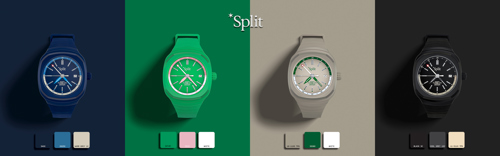
The Split GMT is available in four colourways, each named after a river connected to a defining chapter in music history. They are named as inspiration rather than description, and the colours — beige, blue, black, and green — are the kind of dial tones that work under gloves-off light and gloves-on gloom alike.
The Delta — The first watch to get a name did so almost by accident. When the initial prototypes arrived, Dara asked Ed to pass him "the watch on the table." With several on the table, Ed replied: "the one with the blues." It turned out to be a eureka moment. The Mississippi Delta is the birthplace of the blues, home to artists like Charley Patton, Robert Johnson, and Son House. The beige dial carries that warmth and history.
The Rea — A nod to the emergence of heavy metal, this watch draws its name from a small river in Birmingham, England, where pioneers like Black Sabbath and later Judas Priest developed their defining sounds. The black dial reflects the weight and electricity of that scene.
The Hudson — Named after the river that runs alongside New York City, the Hudson GMT captures the electricity of the CBGB era in the 1970s — the raw energy of The Ramones, Television, and Blondie. Movement, attitude, and edge, like the city itself.
The Westbourne — The trickiest to name. The UK punk scene was centred around the King's Road and Notting Hill, with bands like the Sex Pistols and The Clash. The Thames felt too obvious. Then came the realisation: there is a river running beneath the shops on Westbourne Grove — the River Westbourne — which once flooded the streets above it. The area was where The Clash were based, and where a fusion of punk and reggae sound systems brought people from different backgrounds and identities together. This also brings the collection full circle: The Clash's London Calling album cover was itself a homage to Elvis Presley's first album. Different sounds, same lineage.
The green Westbourne is the one that keeps drawing the eye. On a mountain it reads as intentional without being loud — not the high-visibility green of safety equipment, but the quieter green of a forest at altitude. The blue Hudson sits at exactly the point where it works equally well with technical outerwear and a dinner jacket on a ski holiday, which is a useful quality when your bag allowance is 23kg and a watch is one of the few things you can carry that crosses the mountain-to-restaurant line without effort. Every one of these scenes brought people together — and so does the watch that draws from them.
The Split brand's first collection, the MC chronograph, set the hands at 7:23 rather than the traditional 10:10. The asymmetric position forms a subtle downward curve — a frown — that the founders describe as an invitation to honesty over perfection. It is a small thing, but small things are where character lives in a watch. The GMT builds on that identity: a brand willing to make odd choices for considered reasons is usually a brand worth paying attention to.
Time, like music and rivers, never stands still. The Split GMT doesn't try to be a mountain watch in the obvious sense. There is no barometer, no compass, no orange bezel. What it offers instead is something more useful on the hill and off it: honest craft, a genuinely practical complication executed at a price that doesn't require a second mortgage, and a design that travels from first cable car to dinner table without asking you to change.
For skiers and snowboarders who spend real time between time zones — whether chasing winters across hemispheres or simply coordinating with a team back home while on snow in Europe — the GMT function alone justifies the price of entry. The Miyota movement and the considered material choices do the rest. Split is a new brand with a clear sense of what it wants to be. On this evidence, it has the craft to back it up.


