
On the Wrist, On the Mountain: A Snowsports Review of the Eska Light Racing Sunset Chronograph
13/August/2026

There's a particular kind of watch that looks like it belongs on a rally driver's wrist but ends up, more often than not, strapped over a ski jacket cuff instead. The Eska Light Racing Sunset chronograph — the newest entry-level automatic from the revived French-Swiss brand — is squarely that kind of watch. It was designed with motorsport in mind, right down to its tachymeter scale and racing-inspired bicompax layout. But spend a few laps down a mountain wearing one, and it turns out plenty of what makes a good driver's chronograph also makes a decent companion for a day on snow.
When the late-afternoon sun dips below jagged alpine ridges, casting a warm golden-pink hue across fresh powder, every skier and snowboarder knows the magic of golden hour. It is precisely this atmospheric beauty—and the high-adrenaline demands of mountain speed—that makes the Eska Light Automatic Racing Sunset Chronograph such a compelling companion on and off the piste.
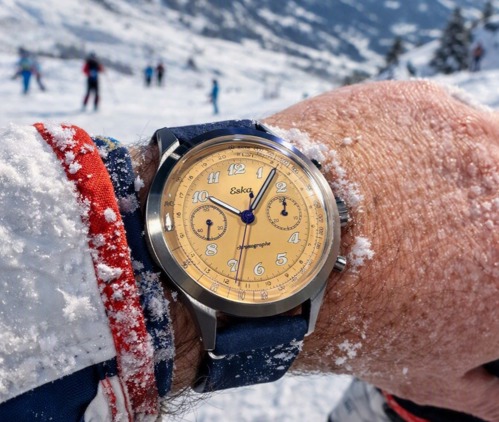
Revived by watch industry veterans Christophe Chevreton and Sinicha Knezevic, Eska’s "Light" collection aims to deliver mechanical automatic chronographs at a remarkably accessible price point. While engineered with motorsport heritage in mind, the Racing Sunset reference feels tailored for winter sports enthusiasts who value functional timing, high-contrast legibility, and effortless après-ski style.
First Impressions: A Sunrise Dial for Alpine Light
The Racing Sunset earns its name from a matte salmon dial that Eska says was inspired by sunrises and sunsets over the Lyon skyline — a scene that's also engraved on the caseback. On the wrist, that warm, slightly dusty orange-pink tone does something unexpected in a snow environment: it pops against white backgrounds in a way that cooler blue or black dials don't. Set against snowpack and bright alpine sky, the contrast between the salmon base, the crisp white printed tracks, and the blue chronograph hand and railway minute markers stays legible even when squinting through goggles or ducking under a raised visor to check the time.
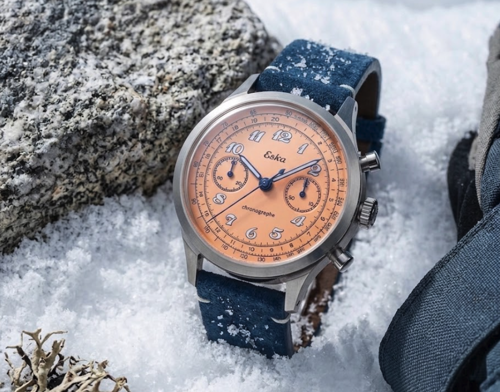
The dial uses italic numerals for a vintage feel, a deliberate departure from its sibling model, the Racing Azur, which sticks to baton indices. It's a small detail, but on snow it matters: numerals read faster at a glance than batons do when your hands are gloved and you don't want to linger.
Mechanical Heart: Reliable Cold-Weather Power
Beating inside the Racing Sunset is the SL4617 automatic chronograph caliber (supplied by Liaoning Peacock Watch Co. and assembled/regulated in France). Built on proven Valjoux 7750 architecture, this self-winding movement offers heavy-duty reliability.
Frequency: 28,800 vibrations per hour (4 Hz) for precise timing split seconds.Power Reserve: meaning you can set the watch down during a rest day at the chalet and pick it up the next morning without missing a beat.
Dual Scales: Integrates both a tachymeter scale (useful for calculating speed over fixed distance markers on speed-skiing courses) and a telemeter scale—traditionally used to estimate distance to visual/audible events, such as distant weather fronts rolling in across the range.From the Summit to Après-Ski
When the lifts stop running and the focus shifts to the fireside lounge, the Eska Racing Sunset shines. Its unique salmon-and-blue palette brings a sophisticated vintage charm that pairs just as naturally with a heavy knit wool sweater as it does with technical outerwear. The screwed-in caseback features an engraved cityscape of Lyon—a subtle nod to European heritage that adds character.
Sizing and Wearability Under Layers
At 41mm across and 12.8mm thick (14.9mm including the domed sapphire crystal), the Racing Sunset sits in a comfortable middle ground — big enough to read easily with gloves on, not so large that it fights with a jacket cuff or wrist gaiter. That thickness is worth flagging for anyone planning to wear it under a shell: at nearly 15mm with the crystal, it's noticeably taller than a simple three-hander, and skiers running snug cuffs or wrist-mounted trail cams may find it a tight fit layered under fabric. Over the cuff, on a ski-glove-friendly strap, it wears comfortably through a full day on the hill.
The 316L stainless steel case and screwed caseback give it reasonable everyday toughness, and the engraved Lyon skyline is a nice touch for anyone who likes a story on the back of their watch even if nobody but them will ever see it.
The Chronograph Function: Useful, With Caveats
This is where the "Racing" branding earns its keep, and also where the snowsports angle gets more nuanced. The dial's tachymeter scale is built to calculate speed over a known distance — traditionally clocked against a car crossing measured mile markers on a track. On snow, the same math technically works: if you know the exact length of a run or a timed course, you can start the chronograph at the top and read your average speed off the bezel scale the moment you cross the bottom. In practice, though, few resort runs are precisely surveyed, and few skiers are going to want to fumble with a chronograph pusher through ski gloves mid-run. The tachymeter is a fun, faithful piece of chronograph heritage more than a genuinely practical on-mountain speed tool — but it's there if you want to play with it on a groomed, known-length course.
More usefully, the chronograph's 30-minute counter at 3 o'clock is well suited to timing runs, lift lines, or laps in a terrain park, and the small seconds subdial at 9 o'clock keeps the watch ticking along even when the chronograph function is idle. The pushers are firm and well-defined enough to operate with a light glove, though thick mitts will likely require removing a hand covering to actuate them cleanly — a limitation shared by nearly every mechanical chronograph at this price point.
Movement and Cold-Weather Performance
Under the dial sits the Peacock SL4617, an automatic chronograph caliber built on the same architectural DNA as the venerable Valjoux 7750 — the workhorse movement that has powered mechanical chronographs across the price spectrum for decades. It offers a power reserve of at least 45 hours and beats at 28,800 vibrations per hour. For cold-weather sports, automatic movements generally perform reliably down to typical resort temperatures, though very cold, dry mountain air can thicken lubricants slightly and marginally affect amplitude — a known characteristic of mechanical watches broadly rather than a flaw specific to this piece. A day of skiing, with the watch kept moving by wrist motion, shouldn't pose any real problem.
Water Resistance: The One Real Limitation
Here's the honest caveat for anyone considering this watch as a dedicated snowsports piece: water resistance is rated at 50 meters. That's enough to shrug off snow, splashes, and the occasional faceplant into powder, but it's not a rating built for submersion, and repeated exposure to slushy, wet conditions — or a dunk in an après-ski hot tub — pushes past what the case is designed to handle comfortably. Skiers and boarders who want a watch that can also swim should look elsewhere; this is a watch that tolerates snow rather than one built to live in it.
Eska positions the Light collection as an accessible, sub-€500 entry point into mechanical chronographs — the Racing Sunset delivers a genuine automatic chronograph movement, sapphire crystal, and a two-year warranty at a price that undercuts most Swiss-branded competitors offering comparable specs. It won't replace a purpose-built ABC (altimeter-barometer-compass) sports watch for serious backcountry use, and its water resistance keeps it out of contention as a true all-conditions mountain tool. But as a watch that looks the part on a chairlift, reads clearly against snow and sky, and can genuinely double as a lap timer between runs, the Racing Sunset earns its keep well beyond the racetrack it was named for. For skiers and snowboarders who want mechanical character on their wrist without babying a five-figure Swiss piece on the mountain, it's a compelling, low-stakes choice.


