
Fischer’s pre-season optimism meets the reality of the Rettenbach Glacier,
22/October/2026

As the world's best alpine ski racers gather on the Rettenbach Glacier in Sölden at the end of October, a new World Cup season is about to begin. After an eventful and successful winter, excitement is building once again. Months of preparation are behind the athletes, equipment is dialed in, and anticipation is growing. Sölden is where the first questions of the season are answered: Who has taken the next step? Who is ready to challenge at the highest level?
The programme begins in the village before the first racer leaves the start hut. Friday evening brings the women’s bib draw at the Giggijoch valley station. Saturday combines the women’s race with a fan-club parade, an evening prize ceremony and the men’s draw, before Sunday’s competition concludes the opening weekend.
The scheduled racing is straightforward:
Saturday 24 October: women’s giant slalom, first run at 10:00 and second run at 13:00.
Sunday 25 October: men’s giant slalom, first run at 10:00 and second run at 13:00.
For Fischer, the mood is captured in the title of its season-opening preview: “Hungry for more”. The manufacturer describes renewed excitement after an eventful and successful winter — a familiar sentiment across the paddock, but one that Sölden is particularly well equipped to test. On the Rettenbach Glacier, anticipation quickly gives way to scrutiny.
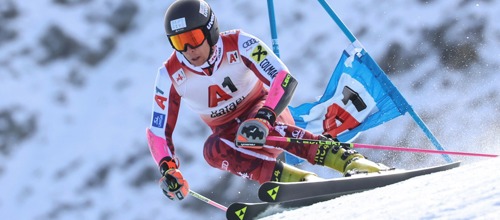
The opener is not simply a ceremonial start. Its altitude, hard racing surface and sustained steep pitch make it one of the circuit’s most demanding giant slaloms, arriving just when athletes have the least competitive rhythm. It is also one of the relatively few World Cup weekends on which women and men race on the same slope.
Racers must establish rhythm on the flatter upper section, commit to their line through the long steep pitch, then preserve enough speed for the run to the finish. The course reaches a maximum gradient of more than 68%, according to the organisers — steep enough to punish a late turn or a loss of balance well beyond the gate where the mistake begins.
That combination makes the opening weekend revealing without making it definitive. A fast performance offers immediate evidence that an athlete’s technique and equipment are working together under race pressure. A disappointing result is harder to interpret: the course demands a particular blend of precision, confidence and early-season sharpness.
For equipment suppliers, the uncertainty is part of the occasion. Sölden’s organisers describe the pre-race atmosphere as one in which athletes and coaches want to discover where they stand against other nations, while manufacturers wait to see whether their skiers can deliver at the front.
Fischer’s race programme faces its first public examination
Fischer’s alpine roster includes Austrian giant slalom specialist Stefan Brennsteiner and Italian technical racer Lara Della Mea, alongside athletes competing across the World Cup disciplines. Their presence in the manufacturer’s programme gives its season-opening message a sporting context, although roster membership should not be confused with a confirmed Sölden start list.
Now, the focus shifts to what lies ahead. After taking the summer to recover, recharge and prepare for the demands of the new season, Stefan Brennsteiner is eager to build on last winter’s breakthrough results. And there is no better place to start than Sölden, a venue that traditionally sets the tone for the months ahead.
Lara Della Mea also showed impressive consistency in the technical disciplines last season. With her performances trending in the right direction, a first World Cup podium finish appears well within reach. If she can carry her momentum into the new winter, it may only be a matter of time.
Behind that roster sits a development process that is less visible than the racing. Fischer says athletes visit its headquarters and production operation in Ried to share feedback directly with staff. Its race department develops and tests prototypes, adjusting equipment to individual needs.
Looking back, last season delivered plenty of memorable moments. Stefan Brennsteiner celebrated the first World Cup victory of his career, reaching a major milestone and confirming his place among the sport's top contenders. Eduard Hallberg also made a strong statement, securing his first World Cup podium finishes and earning recognition as one of the season's rising stars.
Fabian Gratz likewise made significant progress and enters the season with confidence and a strong upward trajectory. Luca Aerni has already demonstrated that he can be a threat not only in slalom but also in giant slalom, making him another athlete to watch closely. Meanwhile, the next generation is ready to make its mark. Young talents such as Miha Oserban and Fadri Janutin are waiting for their opportunity and eager to take the next steps in their World Cup careers.
The crucial phrase is “individual needs”. Racing equipment is not merely a finished product handed to an athlete at the start of winter. In Fischer’s account, it emerges from repeated exchanges between skiers and the people developing their equipment. The World Cup then supplies the competitive test that internal development cannot fully reproduce.
The company also says innovations developed and established in racing subsequently enter other Fischer products. That gives the opening weekend a significance beyond sponsorship exposure: it is a public examination of a development system whose influence extends into the wider ski range.
For Fischer and its competitors, the noise, colour and expectation provide the backdrop. The more consequential moment comes when the first racers reach the steep pitch and the summer’s work has to hold up at speed.
Organisers are promoting a weekend featuring more than 140 athletes and an anticipated crowd of over 30,000, with three days of accompanying events. The scale reflects Sölden’s role as both a World Cup venue and a public launch for the winter season.
Sölden will not settle the season. It will do something more immediate: replace the confidence of preparation with the evidence of a result. Preparations are complete, the final training sessions are done, and expectations are high. The World Cup opener in Sölden marks the start of a winter filled with passion, fierce competition, and unforgettable moments. With the World Championships in Crans-Montana on the horizon, plenty of exciting storylines are set to unfold throughout the season. The stage is set. The athletes are ready.
Related Articles
08/October/2026

14/October/2026

01/October/2026


