
Space-Age Warmth for the High Alpine: How NASA Tech and primaloft are Reshaping Outdoor Performance Apparel
05/November/2026

As mountain athletes prepare for winter expeditions and freezing alpine belays, the perennial gear dilemma remains the same: how to maximize warmth without adding cumbersome weight or bulk. Down insulation has long held the crown for warmth-to-weight ratio, but its performance plummets the moment moisture or sweat enters the equation. Synthetic insulation solves the moisture problem, but traditionally requires thicker layers to match down’s thermal output.
A new generation of technical apparel is solving that trade-off by drawing inspiration from space exploration. By integrating aerogel—a material engineered by NASA to insulate spacecraft and rovers in extreme extraterrestrial environments—brands are bridging the gap between ultralight packability and heavy-duty thermal barrier protection.
From Spacecraft to the Belay Ledge
Originally created to withstand the vacuum and extreme thermal fluctuations of deep space, aerogel is recognized as one of the lightest solid materials known to science. Composed of over 95% air by volume, its porous structure forms an intricate lattice that drastically reduces conductive and convective heat transfer.
Historically, outdoor manufacturers faced a major hurdle when trying to use aerogel in clothing: in its raw form, the material is brittle and prone to shattering under physical stress. Recent breakthroughs in textile engineering have overcome this by embedding microscopic aerogel particles directly into synthetic microfibers.
This synthesis allows technical outerwear to maintain low density and extreme compressibility while creating an ultra-thin thermal barrier against wind and sub-zero temperatures.
How Aerogel Insulation Is Used in Modern Garments
In real-world application, brands apply this technology to target high-exertion environments where weight, weather protection, and warmth intersect.
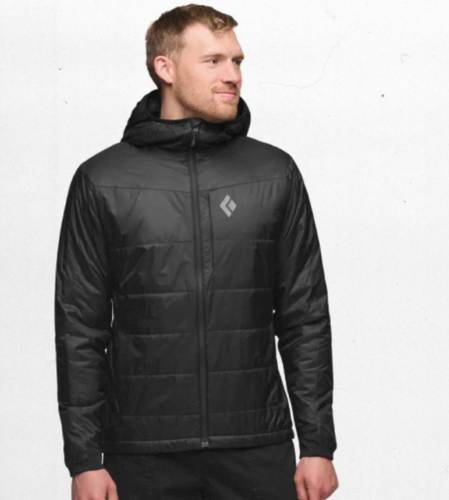
A prime example of this execution is the Black Diamond Solution 2.0 Hoody, which utilizes 60g PrimaLoft Gold Cross Core Insulation. By utilizing a 60g weight fill throughout the garment:
Optimized Warmth-to-Weight Ratio: The jacket leverages NASA-infused aerogel to achieve high-loft thermal performance without the excessive bulk or weight of heavier synthetic fills.
Integrated Weather-Resistant Shell: The 60g PrimaLoft Gold layer works in tandem with a windproof and water-resistant outer fabric, making it a standalone layer during blustery, damp weather or an active mid-layer in extreme freezing environments.
Purpose-Built for Climbing & Mountaineering: Specially designed for stop-and-go alpine pursuits, the insulation structure maintains warmth even when exposed to moisture or sweat during strenuous ascents, while staying lightweight and flexible enough for full range of motion.
Technical Benchmarks: Aerogel-Infused Insulation vs. Traditional Fill
The integration of aerogel into high-loft synthetic fibers fundamentally alters the performance profile of mid-layers and outerwear:
Thermal Efficiency: By trapping air inside a porous nanostructure, aerogel-enhanced synthetics deliver significantly higher insulation per gram than standard synthetic fills.
Wet-Weather Reliability: Unlike goose or duck down, which collapses and loses loft when exposed to rain, snow, or heavy perspiration, aerogel-infused synthetic fibers retain their structure and insulating properties when wet.
Low-Bulk Compressibility: Outerwear built with 60g PrimaLoft® Gold Cross Core™ packs down easily into hand or chest pockets, taking up minimal space inside a mountain pack or clipping directly onto a climbing harness.
Sustainability & Weather Resistance: Modern iterations pair these space-grade synthetics with recycled face fabrics treated with durable water repellent (DWR) coatings, aligning high-performance protection with environmental compliance.
By incorporating aerogel-infused insulation like PrimaLoft® Gold with Cross Core into technical outerwear like the Solution 2.0 Hoody, gear designers are crafting active insulation layers that excel across diverse conditions:
Mid-Layer Utility: Slips easily under a hard shell jacket during severe blizzards without feeling restrictive.
Standalone Outer Layer: Blocks wind and repels light precipitation on dry, chilly ascents or blustery ridge walks.
Emergency Packability: Stows compactly into a harness-mountable pocket as a reliable "just-in-case" layer for alpine routes.
As aerospace materials continue to migrate into consumer outdoor apparel, technical outerwear is becoming leaner, tougher, and significantly warmer—proving that the best defense against winter conditions down on Earth might just come from technology designed for the stars.
The Evolution of Active Insulation
For mountain sports—from ski touring and alpine climbing to shoulder-season backpacking—gear needs to adapt to stop-and-go activity. High-exertion ascents generate intense body heat and sweat, while long belays or summit rests demand immediate warmth against biting winds.
Related Articles
02/November/2026

04/November/2026


